

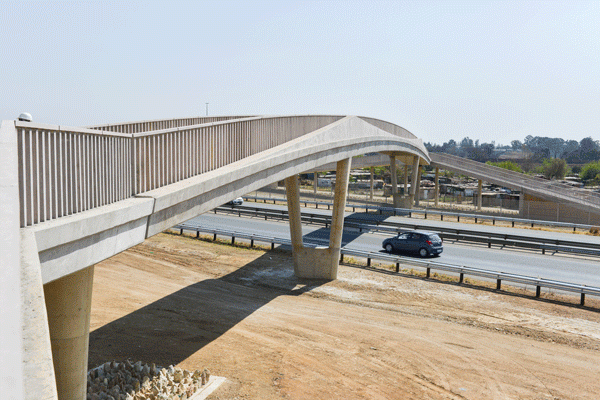
SANRAL-facilitated research provides greater understanding of road user behaviour that will be used to increase safety.
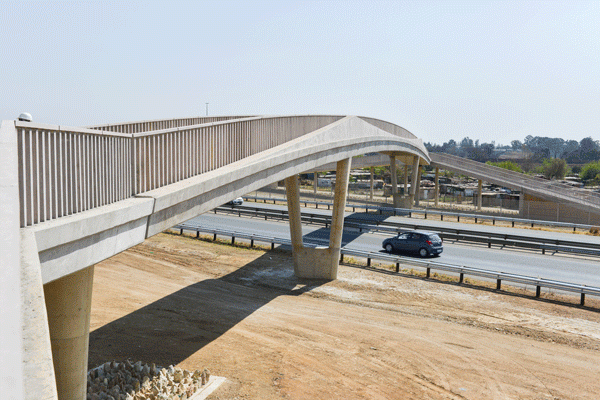 SANRAL recently constructed three new pedestrian bridges on the N17 between Springs and Johannesburg, which promise to reduce the risk of pedestrians and cyclists being run over by cars when crossing the busy highway.
 Research conducted on the Cape Town freeway network is shining more light on why pedestrians cross busy highways, braving the potential danger of being involved in an accident with fast-moving vehicles, despite the presence of pedestrian bridges.
Coordinated by Professor Marion Sinclair of the University of Stellenbosch’s Department of Civil Engineering and Prof Mark Zuidgeest of the Centre for Transport Studies at the University of Cape Town, the study adds to a greater understanding about pedestrian behaviour and will have an impact on the provision of road infrastructure, traffic law enforcement and education and awareness campaigns targeting specific road user behaviour.
The research was facilitated by the South African National Roads Agency (SOC) Limited (SANRAL), which commissioned the pedestrian count and provided the data for analysis.
CCTV cameras on Cape Town freeways monitor the activities of pedestrians, with up to 30000 pedestrian activities being observed on a regular week day.
Crime and time amongst reasons
SANRAL has built several pedestrian bridges across the roads. Part of the research was aimed at determining whether people make use of these bridges and what can be done to influence their choices.
The study found that time saving and a fear of criminals were among the top reasons why pedestrians decided to cross the road, both in instances where bridges were close by and where they were absent.
Many pedestrians were prepared to take the risk of venturing onto the road rather than becoming victims of crime on, or close to, the bridges.
Among the recommendations are that more pedestrian bridges should be erected, but that they cannot be provided without reliable security systems that ensure the personal safety of pedestrians who use them.
This will require partnerships between road authorities and law enforcement in implementing sustainable solutions.
A good example of this is the deployment of additional CCTV cameras as part of the Freeway Management System, located specifically at known hotspot pedestrian bridges.
These cameras are monitored 24/7 by law enforcement operators on the lookout for suspicious behaviour or potential danger.
Press SANRAL Building on 30 Years of Democracy 2 years ago 0 210603 Press SANRAL ADVISES ROAD USERS OF CLOSURE ON R40 NATIONAL ROAD BETWEEN WHITE RIVER AND HAZYVIEW 12 months ago 0 80993 Press SANRAL announces new R2.2 billion project and Contractor Development Programme for N2 Wild Coast Road 1 year ago 0 66421 Press N14 circles in Kathu support industrial development in the Northern Cape 2 years ago 0 60238 Uncategorized UPDATED TRAFFIC ADVISORY: N3 road closure and rescue operations 1 year ago 0 59993 Press Temporary Lane Closures on N17-2, N12-19, N3-12 and R21 OR Tambo for Overhead Sign Replacement. 6 months ago 0 49585 Press N3 FULL ROAD CLOSURE NEAR MARKET ROAD, PIETERMARITZBURG FOR THE DEMOLITION OF THE EXISTING N3 MARKET ROAD OVERPASS BRIDGE 7 months ago 0 46823