

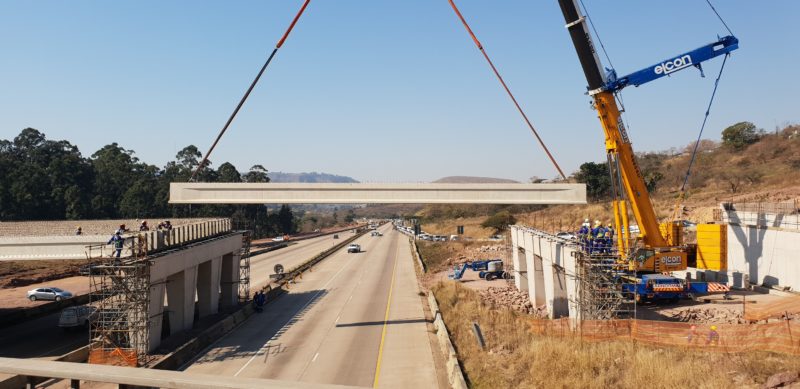
Modern engineering made it possible for a bridge to be erected in two weekends.
The beams were cast in a specialised casting yard five kilometres away from the construction site. It took just four days and minimal disruption for South African National Roads Agency (SOC) Limited (SANRAL) to erect a bridge over both carriageways of a busy highway in KwaZulu-Natal.
Traffic on the N3 from Durban to Pietermaritzburg was recently diverted for two consecutive weekends as a new bridge was erected at Hammarsdale.
The development of the Keystone Park Light Industrial, Warehousing and Logistics Precinct at Hammarsdale has increased the volume of traffic – especially heavy vehicles – using the intersection of the N3 and MR 385.
SANRAL upgraded the interchange from a simple diamond interchange to a new semi-parclo (partial clover leaf) free-flow interchange to prevent a back-up of trucks onto the busy N3.
SANRAL Eastern Region project manager, Stephné Wilmot, said: “Given the high volumes of traffic using the N3 and the urgent need to construct the intersection as soon as possible to alleviate growing congestion by heavy vehicles, it was decided to use time-saving construction measures.”
Ian Jackson, resident engineer at Hatch consulting engineers, said precast beams were used to minimise delays.
He said: “With short to medium span bridges, you basically have three types of decks – cast in-situ; precast beams and deck slab; and a launched deck.
“The cast in-situ is the cheapest but will entail closing a carriageway for approximately three to four months and diverting both directions of traffic onto the one carriageway, and then repeating the procedure for the next deck. Thus, it is time consuming and severely affects traffic.”
A launch deck is cost prohibitive because it is expensive to set up the launch yard, said Jackson. The geometrics of the bridge would only allow the launch of two decks. There are practical and cost constraints.
“Thus, a precast beam deck and slab has the least disruption of the traffic – two days in which to place the beams across each carriageway – and is also the most cost effective,” he said.
Specialised casting yard
Jackson said the beams were cast in a specialised casting yard five kilometres away from the construction site.
The beams were transported from the casting yard to site with special low-bed vehicles.
As each beam weights 37 tons, a large crane was used to lift and place each beam in position.
It took two days to position 23 beams per deck. Owing to the positioning of the crane to lift the beams and the potential danger to traffic, each carriageway was closed during the lifting and placing operation.
Press SANRAL Building on 30 Years of Democracy 2 years ago 0 210603 Press SANRAL ADVISES ROAD USERS OF CLOSURE ON R40 NATIONAL ROAD BETWEEN WHITE RIVER AND HAZYVIEW 12 months ago 0 80992 Press SANRAL announces new R2.2 billion project and Contractor Development Programme for N2 Wild Coast Road 1 year ago 0 66420 Press N14 circles in Kathu support industrial development in the Northern Cape 2 years ago 0 60238 Uncategorized UPDATED TRAFFIC ADVISORY: N3 road closure and rescue operations 1 year ago 0 59992 Press Temporary Lane Closures on N17-2, N12-19, N3-12 and R21 OR Tambo for Overhead Sign Replacement. 6 months ago 0 49585 Press N3 FULL ROAD CLOSURE NEAR MARKET ROAD, PIETERMARITZBURG FOR THE DEMOLITION OF THE EXISTING N3 MARKET ROAD OVERPASS BRIDGE 7 months ago 0 46822